Thank God, I’m Free, Part 1
Ministries > Key Life Network with Steve Brown
References
Matthew Porter: Welcome to Key Life. I'm Matthew Porter, executive producer for Key Life, and you're going to be glad you tuned in today. We're bringing you a classic sermon from Steve titled "Thank God I'm Free," and it's based on John 8:31 through 36. Steve gave this message way back in 1978. We'll get into it today and then continue tomorrow. It's brought to you by the Vault Project. The Vault is an online collection of meticulously digitized and restored classic sermons from Steve, dating all the way back to the early 1970s. We have more than a thousand of those sermons in the Vault already, and thanks to your ongoing financial support, we're adding new sermons every single month. Get all the details at keylife.org/vault. I'll tell you more about the Vault in a little bit, but for now, let's go back in time to enjoy a classic sermon from Steve Brown based on John 8 called "Thank God I'm Free" from the late 70s. Here is Steve Brown.
Steve Brown: We're so busy that sometimes, Father, we forget about you. In the busyness and the push and the hustle, it spills over into your place when we want to do your thing and study your word. Father, there are so many problems that are represented in this place that sometimes in the midst of the panic and the hurt and the fear, it's hard to listen and apply and to put it to work in our lives. Father, there are some here this morning, one who is so lonely that she could cry. Another who is afraid and another who can't get the checkbook to balance and another who looks to the future with fear because of physical problems. There's one here who's making a tremendous lifetime choice. There's a family falling apart. Father, with all of this swirling and much, much more, it's hard sometimes to listen and apply and to hear the soft sound of sandaled feet. So, Father, we come as your people, understanding that when we came to you the first time, we surrendered it all. The trouble we recognize, Father, with living sacrifices is that it keeps crawling off the altar, and it has with us. But teach us to remember that we are your responsibility, that our lives are your responsibility. Teach us to let go to the sovereignty, the grace of the one we would call Father. Now, Father, we would come before you in this time, asking forgiveness, praising your name for your graciousness, but also praying for the one who stands in the pulpit. They call him Reverend, and Father, you know better and he does too. We ask now that you would forgive him his sins that that sinfulness might not interfere with your message. We've come to see Jesus and him only. And we pray in Jesus' name. Amen. This morning we're continuing with our study in the Gospel of John. The text is John 8:31 through 36. Before we turn to that, I want to take just a moment to review some of the things that we've seen. Last week, you'll remember that I took the time to explain why I was not at that time dealing with John 7:53 through 8:11. During the week, I've received an amazing number of comments on that omission, enough to require that I say something else about it, so listen very carefully. First, as I pointed out last week, John 7:53 through 8:11 is not a part of the original manuscripts. The words in those verses are simply not found in any ancient manuscript before the 6th century. That, ladies and gentlemen, is not something I dreamed up because I didn't like the text. It is simply a matter of fact. Secondly, the fact that I didn't teach this particular portion of the Gospel of John does not mean that I don't believe the Bible. It means that I believe it so much that I don't want to tell you something has the stamp of God's word, God's inerrant word, unless it really does. Thirdly, the fact that I didn't teach that particular portion of the gospel doesn't mean that I pick and choose what I like and what I don't like, and what I don't like, I throw out. A part of scholarship is to determine in our modern translations what is and what is not a part of the original manuscripts. That discipline is not based on surmise. It's based on a rigorous set of standards, standards of accuracy, reliability, and authoritative evidence from ancient manuscripts. Let me remind you that to teach something as God's word when it isn't is as sinful and worthy of condemnation as to teach that which is contrary to God's word. Fourthly, I did not skip those verses because I disagreed with them. On the contrary, I feel that those verses reflect an adequate and real picture of Jesus of Nazareth and his acceptance. I believe when the woman was caught in adultery and she was dragged before Jesus, if that text is an accurate representation of an incident that happened—and I'm by no means sure, I'm going to be studying it more and we're going to be dealing with it at the end of John—but when that woman was brought before him and he says, "Woman, where are thine accusers?" and she said, "There are none, Lord," and then he said, "Neither do I accuse thee. Go and sin no more." I believe whether or not that happened, that's the way Jesus is. Let no one go out of here and say Steve doesn't believe in God's grace or Steve doesn't believe that Jesus forgives, because I do. Finally, for those of you who felt as a result of what I said last Sunday that you have in your hands a Bible that is not reliable, let me say that none of the good modern translations fail to point out the problems with this passage. I know of only one other passage in the New Testament with a similar problem, and that's Mark 16:9 through 19. In that case, every good modern translation will point out the difficulties with that passage too. Ladies and gentlemen, one of the miracles of our time is not only the way God has inspired the writers of the Bible so that we have revealed propositional inerrant truth, but the way the sovereignty of God has overruled the transmission of the text from generation to generation, from copyist to copyist. In 1948, a little Bedouin boy on the coast of the Dead Sea, chasing his little puppy, threw a rock into a cave. When he threw the rock into the cave, there was a crash as if a clay jar had broken. That beginning small step led to the greatest manuscript discovery in the last 500 years in the Christian church. Out of those caves around the Dead Sea, we found manuscripts that had at least fragments of every book in the Old Testament with the exception of Esther. In the particular case of the book of Isaiah, we found an almost complete text and scroll of the book of Isaiah. Now, here is the important thing. Those manuscript discoveries predated every manuscript that we had in our hand by 1,000 years. And here's another interesting thing. As the scholars began to unravel the texts, as they began to look at these manuscripts, they found that there was no significant difference between the manuscripts we held in our hand and those found in the Dead Sea. I submit that that is a miracle of our time. I submit that you don't send manuscripts through copyist after copyist after copyist through thousands of manuscripts from generation to generation with no more error than that. The Westminster Confession of Faith stated it well. It says that God not only overruled in the giving of his word, but also in the transmission of his word throughout generations. And he did. Now, I'm not here to defend the inerrancy of our modern translations. I'm not called to do that. But I am here to say that the Bible you hold in your hand, if it's an adequate translation, is actually the word of God. Then last week, if you were here, you remember we examined in detail John 8:12, where Jesus says that he is the light of the world. We saw that in that statement, he was saying something about himself. Psalm 27:1, Isaiah 60:19, Job 29:3, and Micah 7:8 all teach that only God, Jehovah, Yahweh is the light of the world. Jesus said, "I am the light of the world." So, what he was saying? Saying, "I'm God." In the statement, he was saying something about the world. It's a dark fallen race. If you look around this world and you see everything is wonderful, it's a nice place to live, everything is going fine, you ought to take your blinders off or your rose-colored glasses. In the statement, he was saying something about the requirements of being in the light. John 8:12, "He who follows me," Jesus said, "will not walk in darkness." You got to follow him. In this statement, he was saying something about those who live outside the light. To be lost in a dark world and to die that way is the supreme tragedy. And then finally, in the statement, Jesus was saying something about those who live in his light. In John 12:26, we are called, if you're a believer, the children of light. Now, I'm starting at the 31st verse of the 8th chapter of the Gospel of John.
Matthew Porter: Thank you, Steve. All this week, we're enjoying a sermon from Steve called "Thank God I'm Free." We're pausing now, going to hit the pause button, but we will continue from right here tomorrow. Of course, this is just one sermon from a series on John that Steve preached way back in the late 70s. For as little as $5 a month, you can access that entire sermon series right now at keylife.org/vault. That's V-A-U-L-T. We have thousands of classic sermons like this one that are essentially trapped on old tapes and reel-to-reels. Those sermons won't be playable much longer, but thanks to your ongoing financial support, we're constantly working to preserve those timeless messages of grace for us and for future generations. In recent months, we've added sermon series on Philippians, Hosea, Acts. There's also, check this out, a four-part sermon series called "Our Guilt, God's Grace," and we just made available a TV series Steve did with the late Tony Campolo way back in the late 90s called "Hashing It Out." You got to see that. Again, the place to go is keylife.org/vault. Hope you will join us in this ongoing effort. Hey, let me ask you something. Have you been working hard at getting better? How's that going? It's exhausting, right? If you've been struggling, I think you'll appreciate a reminder from Steve in a sermon called "Getting Better," and it's based on Ephesians 2. When you find out how the sanctification process really happens, you may be surprised and possibly relieved. We'll send you that sermon on CD for free. Just call us right now at 1-800-KEY-LIFE. That's 1-800-539-5433. You can also email Steve at keylife.org to order that CD, or you can reach out to us by mail. To mail your request, go to keylife.org/contact to find our mailing addresses for the US and Canada. Again, just ask for the CD called "Getting Better." I'm about to hit you up for a donation, but believe me, just to be clear, the CD is free. Last thing, if you've been blessed by the work of Key Life, would you help share that blessing with others by giving as generously as you're able? You can charge a gift on your credit card or include a gift in your envelope, or you can give safely and securely by text. Just pick up your phone and text Key Life to 28950. That's Key Life, one word or two, doesn't matter, text that to 28950. Key Life is a member of ECFA in the States and CCCC in Canada, and we are a listener-supported production of Key Life Network.
Related Episodes
"How do I know when it's time to wait on God or to take action?"
Friday, September 18
“Christians are not called to manipulate, but to motivate.”
Thursday, September 17
“Manipulation is your sin, if you allow it.”
Wednesday, September 16
About Key Life Network
Key Life exists to communicate that the deepest message of the ministry of Jesus and the Bible is the radical grace of God to sinners and sufferers.Because life is hard for everyone, grace is for all of us. And grace means that because of what Jesus has done, when you run to him, God’s not mad at you.
All of the radio shows, sermons, books, and videos we produce work together toward one mission: to get you and those you love Home with radical freedom, infectious joy and surprising faithfulness to Christ as your crowning achievement.
Learn more: http://www.keylife.org
About Steve Brown
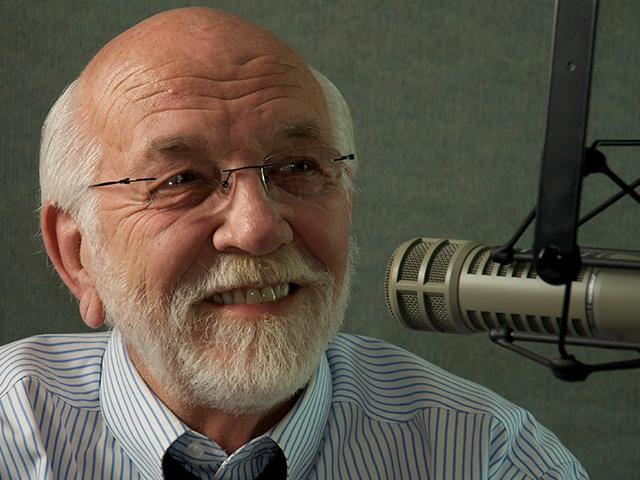
He’s not your mother and he’s not your guru. He’s Steve Brown - a speaker, author, former pastor and seminary professor, and founder of Key Life Network, Inc.
At Key Life, Steve serves as Bible teacher on the radio program Key Life and the host of the talk show Steve Brown, Etc. Prior to Key Life, Steve served as a pastor for more than thirty years and continues speaking extensively.
Steve has also authored numerous books, including How to Talk So People Will Listen, Three Free Sins, Hidden Agendas and his latest release, Talk the Walk: How to Be Right Without Being Insufferable (now available as an audiobook).
Contact Key Life Network with Steve Brown
Key Life Network
P.O. Box 5000
Maitland, FL 32794
In Canada, send requests to:
Key Life Canada
P.O. Box 28060
Waterloo, Ontario N2L 6J8
Telephone Number
1-800-KEY-LIFE


