Matthew 23:23—24:3
Ministries > Thru the Bible with Dr. J. Vernon McGee
https://www.oneplace.com/ministries/thru-the-bible-with-j-vernon-mcgee/
Facebook Twitter Instagram YouTubeThose who think Jesus was “meek and mild” are in for a surprise in this study of His interaction with the “religious” people of His day. In our study of Matthew 23 and 24, Dr. J. Vernon McGee explores what he called one of the strongest statements in God’s Word.
References
Dr. J. Vernon McGee: How firm a foundation ye saints of the Lord is laid for your faith in his excellent word.
Dr. J. Vernon McGee: We have a whole lot of marble tombs walking around. Spiritual zombies, those who are dead in trespasses and in sins.
Dr. J. Vernon McGee: Well, I think that statement by our teacher, Dr. J. Vernon McGee is strong, but just stay with us because he says what we're about to hear next is one of the strongest statements in all of God's Word. Welcome to Through the Bible. I'm Steve Schwetz, your host on this five-year journey through God's Word. Now in just a few moments, we're going to arrive at Matthew 23 and verse 23 where Jesus calls the scribes and Pharisees to account. It's really a powerful study. One that reveals a side of Jesus that, well, may surprise you. So, go ahead, grab your seat on the Bible bus and get comfortable. And while you do, I want to share a few letters from our fellow passengers in Indonesia this time. Many people don't realize that persecution is a daily reality for many believers in Indonesia. And a lot of people don't know it's the most populous Muslim nation in the world. Though about 15% of the population identifies as Christian, over 1 million people in Indonesia can be characterized as unreached by the gospel. In many places, opportunities to share Christ are limited. But God's Word, faithfully translated and broadcast in local languages is going where few people can and it's transforming the lives of listeners. Like Felix, for example, he says, "My faith had become very weak because of many questions about history and religion. But through your programs, I began to see that the Christian faith is rooted in real events and real truth. The teaching helped rebuild my confidence in the Bible." And then Santi shares this, "I went through a period where I was deeply disappointed with people in the church. Because of what happened, I began to question Christianity itself and even thought about leaving the faith. But when I started watching this program, my perspective slowly changed. I began to see that my faith should be rooted in Christ and his word, not in the failures of people. It helped restore my heart." Now our final note comes from His Kendry who says this, "You have really opened my mind and heart to know God and receive his word. Even though I don't have much knowledge about the Bible. I feel like my eyes have been opened to so many things I never understood before. Since I started learning, my life has completely changed. I have more peace in my heart, more joy in my days, and finally, know what it means to walk with God. Even my family feels the difference. We talk to each other more kindly, we forgive faster, and we pray together now." Wow, peace in his heart, joy in his days, and an understanding of what it means to walk with God. You can't ask for more than that. God is so good. Well, if you'd like to join us in praying for listeners like these in Indonesia and around the world, you can sign up for the World Prayer Team from our app at TTB.org as well. And let's pray together. Heavenly Father, thank you for your word that does change lives and brings hope. Continue to go before us, Lord, as we share your word in Indonesia and across the world. And we thank you in advance for what you're going to do in each heart. In Jesus' name we pray. Amen.
Dr. J. Vernon McGee: Turn now to Matthew 23 as we go through the Bible with Dr. J. Vernon McGee.
Dr. J. Vernon McGee: Now today, friends, we return to the 23rd chapter of Matthew and we'll put in it verse 23. Now we are in a section where it's filled with many woes. It's woe, woe, woe, and many of them are here. These woes are denunciations of our Lord upon the religious rulers of that day. It's the harshest language that you'll find in the Word of God. No prophet of the Old Testament ever denounced sin as it's being denounced here by the Lord Jesus.
Dr. J. Vernon McGee: And I wish today that I could get this chapter into the hands of the liberals. I'm of the opinion many of them have never read it. I understand one here in Southern California, when it was called to his attention, didn't even know it was in the Bible. Of course, he'd never read the Bible. And he did not even know this was in the Bible. There is a misunderstanding today of who the Lord Jesus really is. Liberalism has given the impression that he's the love child and that all he ever talked about was love. That's not true, of course.
Dr. J. Vernon McGee: In fact, up at Berkeley, one of the banners that was carried around in the days of the protest up there was, "Jesus, yes, church, no." And a senator from up in Oregon has made a great deal of that because he says the church today is giving the wrong impression and that they want Jesus, but they don't want the church as it is.
Dr. J. Vernon McGee: Well, I disagree with that entirely. My point is, yes, they've misunderstood the church and the church is giving a wrong impression. I agree with all of that. But, my friend, the main problem is they've really misunderstood who Jesus is. He uses the harshest language. He loved sinners and he died for sinners. But, my friend, he's the judge. He's also going to judge sinners. And we need to have a correct perspective of who he is. And therefore, he's misunderstood today. Why, the average conception of the Lord Jesus is not even biblical. And the Jesus of the liberal never did live. He never had an existence.
Dr. J. Vernon McGee: You say, "Well, what do you mean by that?" Well, I mean simply this, because I ask a liberal preacher this, "Does the Jesus that you believe in, was he virgin born?" He said, "No." "Did he perform miracles?" "No." "Did he die on the cross for the sins of the world?" "No." "Did he rise bodily from the grave?" "No." Well, I'd like to know where that Jesus ever originated then. There's no documents that tell about him living in the first century. The only documents that we have tell of one virgin born, a miracle performer, who died for the sins of the world, who rose from the dead, and who ascended into heaven and who's coming as the judge of this earth.
Dr. J. Vernon McGee: My friend, that Jesus is not known today and he's the only one that's ever lived. This other one is a figment of the imaginations. Will you listen to him here now? I know this is strong language. This is strong tea and not everyone can receive it. Verse 23, I'm reading now of Matthew 23.
Dr. J. Vernon McGee: "Woe unto you, scribes and Pharisees, hypocrites! For ye pay tithe of mint and anise and cumin and have omitted the weightier matters of the law, judgment, mercy, and faith. These ought ye to have done, and not to leave the other undone." Now they would tithe these plants that produce condiments like mint and anise and cumin. For instance, when I was a boy, my mother always kept out in the backyard somewhere a little patch of mint to put in iced tea in summertime. And it wasn't much, just a little patch.
Dr. J. Vernon McGee: And can you imagine one of these religious rulers measuring off a little patch of mint and taking a tenth of it to give to the Lord? Oh, they were strict about those little matters. But our Lord says, "You forgot the weightier matters of the law." And those weightier matters would have brought them to the person of Christ, but they forgot them.
Dr. J. Vernon McGee: Then verse 24, "Ye blind guides, which strain at a gnat and swallow a camel." Do you think that's humorous? I do. If I'd have been there that day, I'd have laughed at this one. That is, if I wasn't a Pharisee or a scribe, and if I'd have been there, I sure hope I wouldn't have been one of those. May I say to you, I think this is very funny. But, of course, it's set in a very serious vein here, but I'm sure many in the crowd laughed, especially who knew those old religious rulers.
Dr. J. Vernon McGee: And we've got a lot of folk that make so much of the little things today, they strain at a gnat. They swallow a camel. I know a dear lady and thank the Lord she's now gone to be with the Lord. Oh, she used to argue about lipstick. And you know that she had the meanest tongue of any person I think I've ever met. Now, she didn't think that is bad, but lipstick was terrible. And frankly, I think that how they paint a gossip on the end of your tongue is a lot worse. And especially use that paint to blacken somebody's character or reputation. I think that's a lot worse than just put a little paint on your lips. Some of them would be better without it, of course. But I think all of us ought to look as well as we can, and some of us don't have much to work with, but we ought to do the best we can with what we've got.
Dr. J. Vernon McGee: It's amazing how people can strain gnats and swallow camels even to this good day. I don't know about you, but to me, that's very humorous. Verse 25, "Woe unto you, scribes and Pharisees, hypocrites! For ye make clean the outside of the cup and of the platter, but within they are full of extortion and excess." And I would say that this is a picture of the average church today. They're busy making the outside of the cup and platter clean. My, they go through ceremonies. And they want to have the best equipment. And they talk so nice and pious on the outside. But inside, they don't deal with sin. In fact, they don't like that word. It's a dirty word. And it is dirty, by the way, but that has to be cleaned up.
Dr. J. Vernon McGee: Now listen to him in verse 26, "Thou blind Pharisee, cleanse first that which is within the cup and platter, that the outside of them may be clean also." Now don't misunderstand, the Lord is saying the outside of the platter ought to be clean, too. But you'll give a wrong impression when the inside is dirty and the outside is not. And the place to start is on the inside. Verse 27, "Woe unto you, scribes and Pharisees, hypocrites!" My, he really leveled the gun at this crowd. "For ye are like unto whited sepulchres, which indeed appear beautiful outward, but are within full of dead men's bones and of all uncleanness."
Dr. J. Vernon McGee: Now this to me is the most frightening figure of speech that he ever used. And I would say, the picture of the platter and the cup, cup and saucer, clean on the outside, dirty on the inside is a picture of the average church. But I'm afraid this is a picture of the average Christian today, so-called. I don't think he's a Christian. A great many of people outside, they have beautiful marble and it really looks nice. But inside, dead men's bones. They're dead in trespasses and sins. They have a form of godliness, but deny the power of it to take a sinner, forgive his sins, regenerate him, make him a new creation in Christ Jesus. And, friends, until that's happened to you, your church membership is null and void. And it's nothing in the world but hypocrisy.
Dr. J. Vernon McGee: I think that the average way of bringing in church members today, of just getting nice people, so-called, to join the church is the biggest hypocrite factory that there is possible today. They are living just like the world, may I say to you. We've got a lot of old whited sepulchers walking around today. Walking graveyards, zombies, if you please. Spiritual zombies, dead in trespasses and sins. And I want to tell you, this is strong language here.
Dr. J. Vernon McGee: Now listen to the Lord Jesus in verse 28, "Even so ye also outwardly appear righteous unto man, but within ye are full of hypocrisy and iniquity." Oh, my friend, he's denouncing the religious leaders and that should be denounced, I think above everything else is the fact that the church has gone astray today. And my friend, if you've got a Bible teaching church in your community and a Bible teaching preacher, a man who believes the book and is trying to preach it, for God's sake, stand with him in these days. He needs you and you need him and we today need men to stand for the Word of God.
Dr. J. Vernon McGee: Verse 29, "Woe unto you, scribes and Pharisees, hypocrites! because ye build the tombs of the prophets, and garnish the sepulchres of the righteous." It's amazing today how a preacher or a great evangelist or that sort of thing in his day was absolutely ridiculed, denounced. And that was true of all of them of the past. Spurgeon was denounced in his day. And look at the preachers who quote him today. And Dwight L. Moody was and R. A. Torrey was.
Dr. J. Vernon McGee: My friends, may I say to you, our Lord sure knew human nature and it hasn't changed. He said, "You build tombs to the prophets." After they're gone, you'll build them a tomb. And you garnish the sepulchers of the righteous. And say, "If we had been in the days of our fathers, we would not have been partakers with them in the blood of the prophets." "Wherefore ye be witnesses unto yourselves, that ye are the children of them that killed the prophets. Fill ye up then the measure of your fathers." They're doing the same thing today they did in that day.
Dr. J. Vernon McGee: Now here he comes and this is something that'll blanch your soul. This is something that's devastating to that damnable doctrine of the universal brotherhood of man and the universal fatherhood of God. Listen to him now, verse 33. And those of you that just think he was the gentle Jesus and never said anything that would even hurt anything, why, some of them think he'd never even swat a fly or crush a grape. But apparently he did. Listen now, verse 33.
Dr. J. Vernon McGee: "Ye serpents, ye generation of vipers, how can ye escape the damnation of hell?" Do you know any language stronger than that? There's not a sailor along the waterfront today that can say anything stronger than that. "Ye serpents, ye generation of vipers." What does that mean? Why, you're an offspring of vipers. And now don't give me that saccharin sweetness about the universal fatherhood of God. God doesn't claim you, my friend, if you've rejected Jesus Christ.
Dr. J. Vernon McGee: The only way to become a son of God, to as many as received him, that is the Lord Jesus, to them gave he the right to become the sons of God, even to those that don't do any more nor less than believe on his name. Now, that's harsh. And don't blame me for it, because I'm nice and sweet. I would never say anything harsh like this, but he did. He did, my friends. I'm just saying what he said here. You can't have it much stronger than this.
Dr. J. Vernon McGee: I'm afraid this is a cup of tea that's a little too strong for a great many of the liberal-minded folk today. He was no love child. He came to die for your sins because he loved you. But if you reject him, he becomes your judge. Verse 34, "Wherefore, behold, I send unto you prophets and wise men and scribes, and some of them ye shall kill and crucify, and some of them shall ye scourge in your synagogues, and persecute them from city to city, that upon you may come all the righteous blood shed upon all the earth, from the blood of righteous Abel unto the blood of Zacharias, son of Barachias, whom ye slew between the temple and the altar."
Dr. J. Vernon McGee: Apparently that was an incident in that day. And he begins right at the beginning and brings them down to the present hour that these are to be judged, my friend. He's not making any distinction here. That is made today. "Well, we know that everybody will ultimately be saved." He says not. He makes it very clear they will not be.
Dr. J. Vernon McGee: "Verily I say unto you, all these things shall come upon this generation." He's looking forward now to the destruction of Jerusalem in 70 A.D. And what does he do now? The one who made this strong denunciation now will weep over Jerusalem. Listen to him now. "O Jerusalem, Jerusalem, thou that killest the prophets, and stonest them which are sent unto you, how often would I have gathered thy children together, even as a hen gathereth her chickens under her wings, and ye would not! Behold, your house is left unto you desolate. For I say unto you, ye shall not see me henceforth, till ye shall say, 'Blessed is he that cometh in the name of the Lord.'"
Dr. J. Vernon McGee: Now, Jerusalem has rejected him in the triumphal entry. Now, he rejects Jerusalem, but now he weeps over this city. You see, he denounced, yes, but he did love them. And the judgment now must come and he weeps. Someone made the statement in Dwight L. Moody's day that he was the only man that ever lived that they thought could preach on hell. Harsh-minded or a person with a very strong personality, maybe ought not to preach on hell unless you're moved by it. Not at all.
Dr. J. Vernon McGee: Remember they thought he was Jeremiah because he could weep. Jeremiah gave the strongest message in the Old Testament, but he wept over it. And I'm of the opinion that we ought to be very careful today about our denunciation unless we are moved emotionally by it. And if we're not, maybe it'd be better not to say anything at all.
Dr. J. Vernon McGee: Now, that brings us to the Olivet discourse. Matthew 24 and 25. And we're going to give some time to this Olivet discourse. You see, not only were these religious rulers in shock, but his apostles were also at this. And this seemed to be a strange turn of events for them. They thought he would establish the kingdom and that Jerusalem would become the capital. But now their house is to be left unto them desolate. And they'll not see him until they do say, "Blessed is he that cometh in the name of the Lord." They rejected him.
Dr. J. Vernon McGee: Now, it is going to the cross. Now what's going to happen in the meantime? Well, these apostles have some questions and they're really shocked at what he said. Now I'm reading chapter 24 and we begin the Olivet discourse and we'll put down a proper introduction for it next time. "And Jesus went out and departed from the temple, and his disciples came to him for to show him the buildings of the temple." Why, he said to the crowd there that day that the place would be desolate. This house would be desolate. Was Herod's Temple? It had already been 40 years in building, and it was destroyed in 70 A.D. before it was finished. And now he says it's to be destroyed or left desolate. And the disciples come and say, "You take a look here at these buildings. It's not desolate now." And Jesus said unto them, "See ye not all these things." They thought they saw it. And they ask him to take a look. And he says, "Do you really see it?"
Dr. J. Vernon McGee: And by the way, friends, do you see your hometown or where you live today as God sees it? When we first came to Southern California, we spent every Monday, my day off, riding around, looking at this fantastic place. It was fantastic in those days before everybody in the world tried to get out here. And it was a beautiful place. I'd say to my wife, though I'd say, "You know, all of this is under judgment." We really don't see it as it is. The judgment is coming upon all of this. And God will judge this area. Do you really see all of this that's around us today, friends, passing away? All these cultural centers, these great schools, these great institutions, these skyscrapers, these great cities, they're all going to pass away.
Dr. J. Vernon McGee: "Do you see all these things?" Now listen to him. "Verily I say unto you, there shall not be left here one stone upon another, that shall not be thrown down." It's all coming down, every bit of it. Now, if you think the first statement put them in shock, they right now, my friend, in trauma. And they're really in a bad way now. Notice, as he sat upon the Mount of Olives, the disciples came unto him privately saying, now they come to him. They've talked it over, I'm sure. They come to him with three questions and he's going to answer these three questions, friends. And the Olivet discourse is another one of the discourses where the fanatics, all of these schisms today, all of these cults, they make a great deal of it. And when anyone wants to be sensational.
Dr. J. Vernon McGee: Now the Lord Jesus is not talking about everything under the sun here. And he's not talking about the church here. The church is not in the Olivet discourse. He's answering three questions. Now briefly, I'll read them and come back and begin here next time. "First, tell us, when shall these things be?" When? The time will come when one stone will not be left upon another. Number two, "And what shall be the sign of thy coming?" And third, "What is the end of the world?" is my translation and yours, but it should be age. The world never comes to an end, but the age is coming to an end. Now what is the sign of the end of the age and what is the sign of his coming? And he'll answer them in that order, by the way. And these are the three questions he'll deal with. He'll not talk about anything else but these three things because he's answering a question, or three questions here, three in one, as it were.
Dr. J. Vernon McGee: Now we'll take that up next time as we come to the Olivet discourse, one of the most important that he ever gave. Until then, may God richly bless you, my beloved.
Dr. J. Vernon McGee: Do you want to hear more? Well, let's read Matthew 24 and 25 together carefully so we can be prepared for what we're going to study next. And as you read, make some mental notes on how Jesus answered these three questions. When will these things be? What will be the sign of your coming? And what is the sign of the end of the age? These next couple of chapters, they're pretty important as they lay the foundation for understanding other books, such as Daniel, Zechariah, and Revelation, which come along toward the end of this five-year journey through the Word of God. So let's be prepared. To get your bookmark with our reading schedule for all of our studies, just call 1-800-65 Bible. That's 1-800-65 Bible and request to be added to our mailing list. The schedule is also available in our app or at TTB.org. And when you're in touch, tell us how you listen to Through the Bible. Is it by our app, online, YouTube, or your favorite radio station? However you hop aboard the Bible bus, it really does help us to know that information. And it helps us to be good stewards of what God has so graciously given to us through your support. So thanks in advance for the help. I'm Steve Schwetz and I certainly look forward to studying God's Word with you next time, here on Through the Bible.
Dr. J. Vernon McGee: Jesus came all to heal my soul. Sin had left the crimson stain. He washed it white as snow.
Dr. J. Vernon McGee: Through the Bible is a five-year study of God's entire word and together we discover God's purposes in history and our lives, found only when we believe in Jesus Christ. Do you know him yet?
Related Episodes
Matthew 22:15—23:22
Friday, August 14
Matthew 21:18—22:14
Thursday, August 13
Matthew 20:24—21:17
Wednesday, August 12
About Thru the Bible
Thru the Bible takes the listener through the entire Bible in just five years, threading back and forth between the Old and New Testaments. You can begin the study at any time. When we have concluded Revelation, we will start over again in Genesis, so if you are with us for five years you will not miss any part of the Bible.
Other Thru the Bible Programs:
Thru the Bible - Minute with McGee
Thru the Bible - Questions & Answers
Thru the Bible - Sunday Sermon
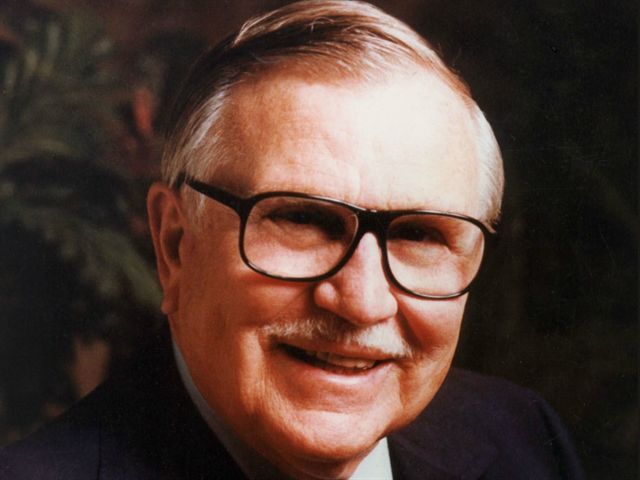
About Dr. J. Vernon McGee
John Vernon McGeewas born in Hillsboro, Texas, in 1904. Dr. McGee remarked, "When I was born and the doctor gave me the customary whack, my mother said that I let out a yell that could be heard on all four borders of Texas!" His Creator well knew that he would need a powerful voice to deliver a powerful message.
After completing his education (including a Th.M. and Th.D. from Dallas Theological Seminary), he and his wife came west, settling in Pasadena, California. Dr. McGee's greatest pastorate was at the historic Church of the Open Door in downtown Los Angeles, where he served from 1949 to 1970.
He began teaching Thru the Bible in 1967. After retiring from the pastorate, he set up radio headquarters in Pasadena, and the radio ministry expanded rapidly. Listeners never seem to tire of Dr. J. Vernon McGee's unique brand of rubber-meets-the-road teaching, or his passion for teaching the whole Word of God.
On the morning of December 1, 1988, Dr. McGee fell asleep in his chair and quietly passed into the presence of his Savior.
Contact Thru the Bible with Dr. J. Vernon McGee
Mailing Address
Thru the Bible, Inc.
P.O. Box 7100
Pasadena, CA 91109
In Canada:
Box 25325,
London, Ontario
N6C 6B1
Phone Number
(626) 795-4145 or
(800) 65-BIBLE (24253)


